An interview on Mahmoud Darwish, Poet Laureate of the
Palestinians, 1941-2008, with Houston-based Palestinian
American poet and Iraqi poet, also a professor at New
York University.
Nadwah - Hong Kong
Thursday, 14 August 2008 15:11
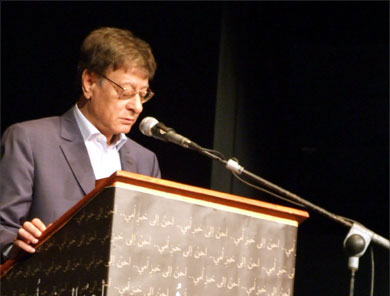
Mahmoud Darwish, Poet Laureate
of the Palestinians, 1941-2008
Three days of mourning have been declared in the West Bank
and Gaza to mark the death of Mahmoud Darwish, the Poet
Laureate of the Palestinians. Darwish was considered one of
the most important Arab poets, a towering literary figure
for over four decades. The poetry of Mahmoud Darwish is well
known and loved across the Arab world by people from all
walks of life.
Fady Joudah, Houston-based Palestinian American poet,
physician and translator. His award-winning poetry
collection is titled Earth in the Attic. He has translated
recent collections of Mahmoud Darwish's poems into a
compilation called The Butterfly's Burden.
Sinan Antoon, Iraqi poet, novelist, translator and
filmmaker. He is a professor at New York University, where
he teaches Arabic literature. He has translated many of
Mahmoud Darwish's poems, including those in the 2003
collection Unfortunately, It Was Paradise. Antoon's latest
collection of poetry was published in English as Baghdad
Blues last year, and his novel is titled Ij'am: An Iraqi
Rhapsody.
AMY GOODMAN: You
have been listening to the poetry of Mahmoud Darwish. Three
days of mourning have been declared in the West Bank and
Gaza to mark the death of Mahmoud Darwish, the Poet Laureate
of the Palestinians. Darwish was considered one of the most
important Arab poets. He died on Saturday at the age of
sixty-seven years old at the Memorial Herman Hospital in
Houston from complications following heart surgery.
A small memorial service was held in Houston Sunday, and
tens of thousands are expected to converge on the official
state funeral in the West Bank city of Ramallah.
A towering literary figure for over four decades, the poetry
of Mahmoud Darwish is well known and loved across the Arab
world by people from all walks of life.
Darwish was born on March 13, 1942, in the village of Birwe
in Palestine. When he was six years old, the Israeli army
occupied and then destroyed Birwe and over 400 other
Palestinian villages. His family fled to Lebanon, then
returned illegally to a nearby village of Dayr-al-Asad.
Darwish and his family became internal refugees living under
Israeli military rule, legally classified as "present-absent
aliens." By the time Darwish left the country in 1970, he
had been imprisoned several times for reciting his poetry
and traveling from village to village "without a permit". He
lived in exile until 1996, when he was allowed to return to
visit his mother.
Mahmoud Darwish was politically active for much of his life,
has often been called a poet of resistance. He was a member
of the Israeli Communist Party in the '60s, then joined the
Palestinian Liberation Organization, or PLO. He was a member
of the PLO's Executive Committee until he resigned in 1993
over the Oslo Peace Accords.
Darwish has written over thirty volumes of poetry and prose
and has been translated into thirty-five languages. He
published his first book of poetry, Wingless Birds, at the
age of nineteen. He won a number of awards during his life,
including the Lenin Peace Prize in 1983 and the Lannan
Foundation Prize for Cultural Freedom in 2001.
I'm joined now by two poets who have translated some of
Mahmoud Darwish's work, and we welcome you both to Democracy
Now! Sinan Antoon is with us in our firehouse studio in New
York, an Iraqi poet, novelist, translator, and filmmaker,
and a professor at New York University, where he teaches
Arabic literature. His last collection of poetry was
published in English as Baghdad Blues.
Welcome to Democracy Now!
SINAN ANTOON:
Happy to be here.
AMY GOODMAN: Talk
about the significance of Mahmoud Darwish.
SINAN ANTOON: It's
really difficult to really encompass his significance on so
many levels, as you mentioned, on the Palestinian level, but
also as a cultural icon, but I would say also as probably
one of the last great world poets, because while he started
his early career as a poet of resistance, as he was known,
but his genius was in transcending himself and to, first of
all, bringing the Palestinian tragedy onto the world level,
but also transcending himself from a local great famous Arab
poet to a world poet who was able really to also elevate, I
would say, the general poetic taste in the Arab world and to
strike a balance between the personal and the political and
the balance between being a very important political poet
but also becoming something much more than that throughout
his career, and especially developing so much in the last
ten or fifteen years, at a time when most poets really
struggled to write anything new.
AMY GOODMAN: How
did you come to know him?
SINAN ANTOON: You
know, Darwish's poetry is like bread. I mean, that's why so
many of us were shocked, because we somehow took it for
granted that he would always be there. But growing up in
Iraq, we always read his poetry in schoolbooks, but also he
would come to many of the cultural festivals in Iraq. And
anyone who was interested in poetry—and, you know, poetry is
the premier literary form and cultural form there, both—so
there is no escaping not being exposed to Mahmoud Darwish
and coming to love his poetry, especially in the mid-'80s, I
would say, when he inhabited a new level, beyond just being
the poet of resistance and the poet of Palestine. And I
should say that many—of course, most of the obituaries,
especially in English, are reducing him just to the poet of
the Palestinian people, and he was that, but he was much
more, as well.
AMY GOODMAN: Did
you meet him personally? When did you meet him personally?
SINAN ANTOON: I
was fortunate enough to meet him personally twice: in
Philadelphia, when he came to receive the Lannan Prize, but
also in Cairo in 2003, where he came from Ramallah to recite
poetry in Cairo. I was fortunate enough to meet him with
some of his translators there.
AMY GOODMAN: I
wanted to go to Houston, actually where Mahmoud Darwish
died, to Fady Joudah, the Houston-based Palestinian American
poet, who is also a physician and a translator. You work at
the hospital where Darwish died?
FADY JOUDAH: No, I
trained at it. But no, I do not work at it, the hospital,
now.
AMY GOODMAN: Can
you talk about Darwish's significance and how you came to
know him?
FADY JOUDAH: I
think Mahmoud Darwish is perhaps the most beautiful aspect
of Palestine, Palestinians and the Arab world and the Arab
language in its contemporary moment. And having that much
beauty, certainly, as Sinan mentioned, takes him beyond the
local and the regional into a global and universal status.
He was a very—a very shy, shy man who was—who people flocked
to, and he also was a very gentle and generous man who knew
a lot of wanted so much from him—a cup of coffee, a
conversation, a signature. He had— he cherished his private
life a lot, because he also knew that his—most of his other
life was public. In his great poem "Mural," he ends it with
a line: "I am not mine, I am not mine, I am not mine."
And even in his death, untimely and premature, he had—he
spoke true words. He had an amazing prescience, and it is
part of his brilliance that all through the decades he could
always write things that you could return to ten or twenty
years later and realize that he had an amazing sense of
vision and timelessness.
AMY GOODMAN: Fady
Joudah, you translated his last work, The Butterfly's
Burden. Can you talk about that?
FADY JOUDAH:
Mahmoud Darwish is a poet who endlessly tried to renew
himself. Again, Sinan said, you know, most accomplished
poets, they stagnate in their twilight years, in their late
styles, in Adorno's or Edward Said's phrase, but Darwish
didn't believe in anything like that. He believed in a
continual renewal of birth, and he always loved his newer
works. And I wanted, when I got in touch with him, to not
focus on what most of the Arab readers in the Arab world,
you know, and even in outside the Arab world, always focus
on his, you know, epic poems from the '80s and the '90s and
even earlier than that. And he always wanted to take the
reader with him to his newest work, to his newest elevation
of language and aesthetic.
And I focused on his latest work, the—collected three books
in one volume. The first book was called—is called The
Stranger's Bed, which is a collection of love poems, a
dialogue between his "I" and his feminine "I," and it
incorporates a lot of the fundamentals and traditional
canon, I guess, of love poetry developed into a contemporary
and modern form and ideal; and also "A State of Siege,"
which was a memoir lyric poem for the destruction of
Ramallah on the opening days of the Second Intifada; and
then, after that, a beautiful book, which I think was really
a mark of a new breakthrough in his poetic sensibility,
Don't Apologize for What You've Done.
And in part, I wanted to do that because one of Darwish's
brilliant features, I guess, is his ability to always change
his language. And The Stranger's Bed was in 1998, and Don't
Apologize for What You've Done was in 2003. And if you read
the first poem in the book and you read the last poem in the
book, you know that there has been a change in the language,
moving towards more conversational speech and perhaps daily
speech, as he would tell me, still a high lyric and complex
metaphors. But it was something I admired about him a lot,
and I think a lot of other people always admired his ability
to always renew his work. And I wanted to put that in
English.
I don't think that he—unfortunately, it saddens me to say
that he's a latecomer into English. He has been celebrated
the world over, but I think—I wish that he had been received
and celebrated in English, since, again, as Sinan mentioned,
his rise to a class of world poet in the mid-'80s and the
early '90s—I don't know if that was a problem of not finding
the right translators. It could be. But I'm not sure exactly
that that would be the sole reason. I don't know exactly
what the other reasons are.
AMY GOODMAN: Fady
Joudah, could you read the last poem, his final poem, that
you are translating now?
FADY JOUDAH: No,
unfortunately, I cannot. It's a poem that would probably
take twenty minutes to read. It's an epic poem called "The
Dice Player."
Mahmoud Darwish called me about three months ago, told me
about his deteriorating medical condition. And then I—a
month later, I knew—I read—I heard that he had read the poem
in Ramallah, and when I read it, I knew exactly that he was,
you know, betting or, you know, throwing the dice on the
possibility that this would be his last poem. And he
requested from me that I translate it.
I can tell you that it begins with: "Who am I to tell you,
who am I to say to you what I say to you?" And Darwish's
"Who am I?" in previous poems has always been a—had the tone
of a more of a true question that really addresses the
knowledge of the self. But in this poem, I think, it took on
a different tone of humility and resignation, because in its
last stanza, he repeats it, and he says, "Who am I to
disappoint the void? Who am I? Who am I?"
AMY GOODMAN: Fady
Joudah, you're in Houston. You're a doctor there. You're a
poet. And the first memorial service, funeral, has been held
for him there, before Ramallah. Can you talk about what
happened in Houston yesterday and also how Mahmoud Darwish
died?
FADY JOUDAH: Well,
he underwent a necessary major vascular surgery and a
surgery that carries a high amount of risk, sort of a
Catch-22. He was a brave man who loved life and loved to
live it in full dignity, and he decided that he did not want
to live with the shadow of death or of sudden death hanging
over him, and he decided to go with the hope of coming out
with a new life or a lease on life, if you will, with this
major surgery, knowing very well that if something did go
wrong, he would not be the same Darwish. And I know in my
heart that—and I know he told me this personally, that he
wanted, that if things did go wrong in the surgery, which,
of course, as I said, it's a—was a very high-risk surgery,
that he just wished not to, you know—not to survive it. And
somehow, I believe that his body willed it. He's very full
of dignity, as I said, and he would not want to live half
the man or three-quarters of the man he used to be.
It was—there was a prayer for the dead, for his body,
yesterday in the central mosque in Houston. About 200 people
showed up. And then, later on in the evening, there was a
memorial service, where several people spoke and honored
him. And also, a representative from the Palestinian
Authority, Rafiq Husseini, came, because several people from
the Palestinian Authority were coming to accompany the body
back to Amman, Jordan, I think, where it would arrive today.
It was a service where you can see the mixture of public
relations to Darwish, where, you know, most people don't
know, you know, how Darwish loved his coffee or loved his
milk or how he slept or how he woke or—he was a
larger-than-life figure for us, and I think, for many of us,
we—because we did not get the chance to know him, except
through his poetry or through his public appearances, you
know, we forget that he was a man like us, you know, got up,
shaved, took a shower, went to the bathroom, and all these
simple daily things.
And it was hard to try to focus on him as a person and not
on him as a legendary figure who, as he says in one of his
poems, both truly and sarcastically, lived like no other
poet has lived, a sage and a king. And it's an amazing feat,
I think, to know that you have achieved immortality in your
lifetime through your art, and as he says, "Death, all the
arts have defeated you, Death." And he knows that his art
has defeated death.
AMY GOODMAN: Many
of Darwish's best love poems have become well-known songs
throughout the Arab world, because they were set to music by
the Lebanese musician Marcel Khalife. I interviewed Khalife
last year and asked him about Darwish's influence on his
life and why he dedicated his latest album to Darwish. I
want to turn to his response, but first, an excerpt of
Marcel Khalife singing "Umi," or "My Mother."
MARCEL KHALIFE:
[translated] At the beginning of the Lebanese civil war, in
'76, I was confined to my village because of the political
events. I was not in agreement with the political tribe in
our area, the eastern area, so I had to stay indoors, in my
house. In that retreat, I only had the oud and the books of
Mahmoud Darwish.
I had just graduated from the conservatory. I was an
ambitious young man who wanted to change the world. But in
the final analysis, one cannot even change oneself. I said
to myself, I have to do something.
I began putting these Mahmoud Darwish poems to music. I put
them to music so that I could feel my own presence. I never
thought that they would become popular songs and sung by
millions of people. I felt that Mahmoud Darwish possibly
wrote his words for me, or it was revealed to me, a
relationship that dates back thirty years with the poetry of
Mahmoud Darwish.
And this work, I wanted to dedicate to him. My voice is not
part of this work, and neither is his poetry. But I have
always felt that his mother's bread is like my mother's
bread, and the eyes of his beautiful Rita, look like the
eyes of my beautiful Rita. His red Indians also look like
mine. His sand and his birds also look like my sand and my
birds. That's why I dedicated this work to him.
AMY GOODMAN: That
was Marcel Khalife talking about the significance of Mahmoud
Darwish's work. Sinan Antoon, can you talk about the growth
of Darwish's work and its effect inside and outside the Arab
world? He was also extremely accomplished in Hebrew.
SINAN ANTOON: Yes.
Well, as I said before, I mean, he started out within what
we call the poetry of resistance, inside, when, of course,
Palestinians, their movement was confined and their identity
was being erased, if we all remember how Golda Meir said
notoriously, "There are no Palestinians." So Mahmoud
Darwish's response was, "I am an Arab"—or "Register: I am an
Arab, and I exist." And he also—his own life, in a way,
encapsulates the Palestinian tragedy, in terms of
confinement, in terms of having his village destroyed, and
then of being continuously displaced. But by the time he
left to the Soviet Union and then to Cairo, he had already
been very famous. But then he also accompanied the
Palestinian saga through Beirut and then the exodus from
Beirut.
And there are many of the poets of resistance who were
famous at the time but kept on writing in the same vein, but
Mahmoud is the one who really changed and evolved. And an
important factor here is that he was a voracious reader, and
he was really open to all of the world traditions. I mean,
he, himself, says always that every poet contains thousands
of poets within him. So, he contains multitudes, because he
really mastered the Arabic tradition, but he was a voracious
reader, open to all world traditions. And you can see
through his poetry that he tried to weave in the Palestinian
saga into other tragedies of native peoples, including the
Native Americans here. Perhaps one could say that if even
Ariel Sharon had to admit that he loved and admired Mahmoud
Darwish's poetry, that really says something, because if
poetry can pierce Sharon's heart, then that is really some
powerful poetry.
But I want to add that he's also a really great prose writer
and one of the greatest prose writers we have. In his famous
Memory of Forgetfulness, the journal about the Beirut siege,
but also recently he wrote an unbelievable prose work called
In the Presence of Absence, and kind of anchored, so while a
great poet, at the same time he is really a great essayist.
AMY GOODMAN:
Mahmoud Darwish appeared in the 2004 film by the acclaimed
French director Jean-Luc Godard called Notre Musique. This
is an excerpt of Darwish's conversation with an Israeli
journalist.
MAHMOUD DARWISH:
[translated] Truth has two faces. We've listened to the
Greek mythology, and at times we've heard the Trojan victim
speak through the mouth of the Greek Euripedes. As for me,
I'm looking for the poet of Troy, because Troy didn't tell
its story. And I wonder, does a land that has great poets
have the right to control a people that has no poets? And is
the lack of poetry amongst a people enough reason to justify
its defeat? Is poetry a sign, or is it an instrument of
power? Can a people be strong without having its own poetry?
I was a child of a people that had not been recognized until
then. And I wanted to speak in the name of the absentee, in
the name of the Trojan poet. There's more inspiration and
humanity in defeat than there is in victory. If I belonged
to the victor's camp, I'd demonstrate my support for the
victims.
Do you know why we Palestinians are famous? Because you are
our enemy. The interest in us stems from the interest in the
Jewish issue. The interest is in you, not in me. So we have
the misfortune of having Israel as an enemy, because it
enjoys unlimited support. And we have the good fortune of
having Israel as our enemy, because the Jews are the center
of attention. You've brought us defeat and renown.
AMY GOODMAN: That
was an excerpt of Mahmoud Darwish in the film of Jean-Luc
Godard. We now turn to the words and voice of Mahmoud
Darwish, his poetry, his poem "I Am."
MAHMOUD DARWISH:
[translated] The echo gets closer, breaking the distance,
thundering, finds the echo and resounds: forever here, here
forever. And the time has gone. The echo has become a
country, here. O father, crack the walls of the universe,
echo surrounding the echo, and let it explode! I am from
here, and here I am, and I am I, and here I am, and I am I.
AMY GOODMAN:
Mahmoud Darwish. In 2000, the Israeli Ministry of Education
proposed introducing his works into the school curriculum
but met strong opposition from right-wing protesters. The
then-Prime Minister Ehud Barak said the country was not
ready.
Mahmoud Darwish died this weekend in Houston, Texas, his
body being flown to Ramallah, where there will be a major
funeral, thousands expected, on Tuesday. We will continue to
cover Mahmoud Darwish, his poetry, his legacy and what
happens in these next few days. Fady Joudah, thank you for
joining us, Houston-based Palestinian American poet and
physician; and Sinan Antoon, joining us here in New York,
Iraqi poet and professor at New York University.
Democracy Now