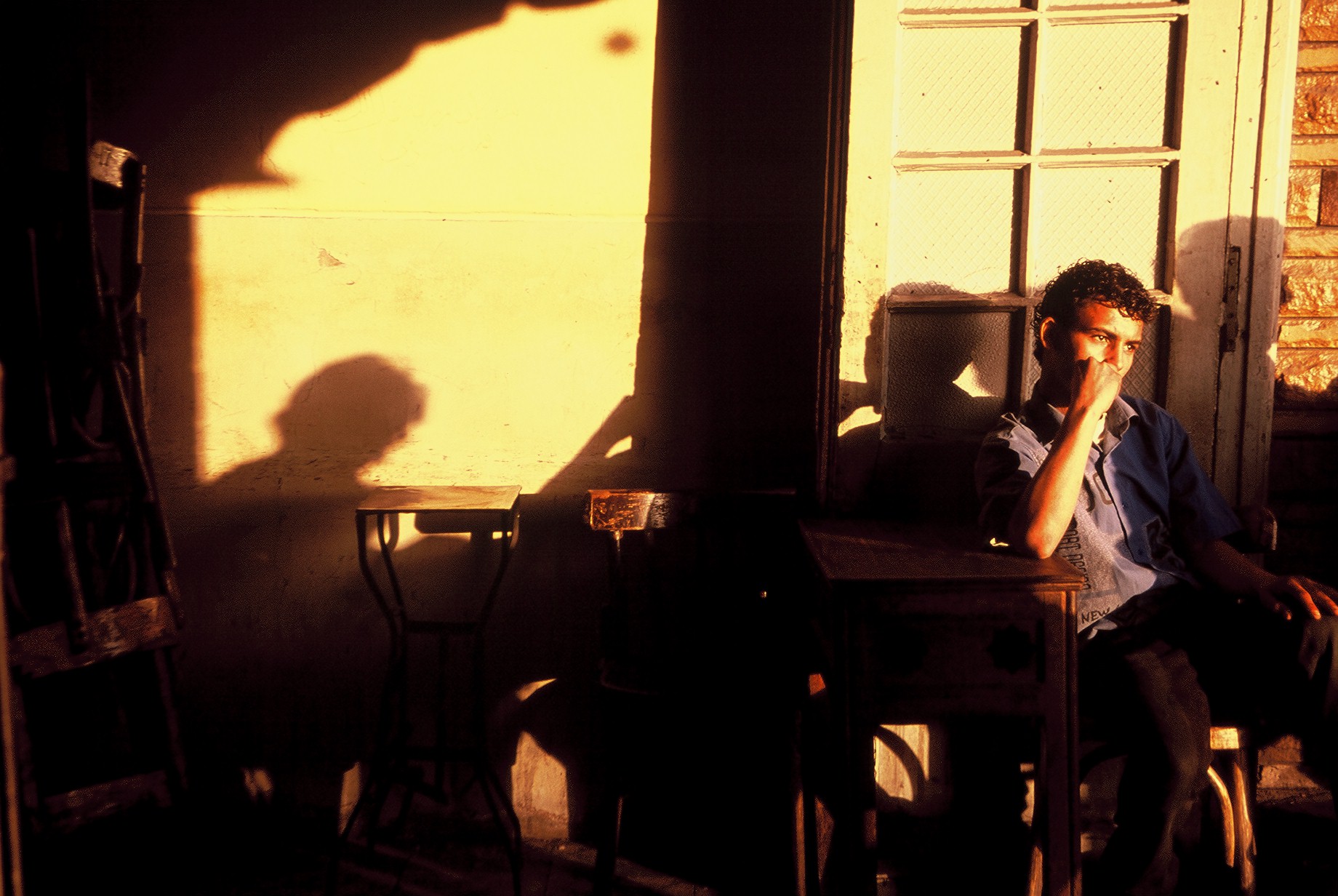
A Cairo Song
by Madeleine Marie Slavick
The first sound in the Middle East is the robes of two men at the
transit airport: very starched, very white, and rustling, like oversized
wings, or crisp sails being shaken.
I learn how to say Bahrain: Bach, and rain, where it’s all balm and
smells of green sea and women dance their bellies to a crowd of three at
the Supernightclub. A sheesha rests against stucco. No ripples in
the pool.
Flying on to Egypt, sky merges with haze, haze with horizon, then the
sand monologue: banks, drifts, dunes, and for a while, a weird geometry
appears: full- and semi-circles of rice farms.
Cairo, ‘mother of the world’, confluence of Asia and Africa, Africa and
Europe, of life and afterlife.
Zachariah meets us at the airport, says, ‘Muslims and Christians live
peacefully here; my name is used by them both.’ The scenery from his
late afternoon taxi: details of the colonial, billboards of Nestle, many
military clubs, a mosque at every block. Then small white neon crosses
atop a Coptic church — almost a floating graveyard.
We too quickly cross the Nile. Like a birthday.
We wander as the early evening muezzin half speaks, half sings. Pass
fruit stalls lit up and happy, large straw trays full of flat round
bread. See shops vacated of keepers, full of incense and Allah. The door
of the mosque is peopled with empty shoes, all men’s.
A Nile fish smiles as we dine, daubed with lemon and oil and a dash of
unidentified spice. By trees trimmed like fez, a Turkish coffee
sweetness.
The night River gets historical, with or without felucca dressed
in neon and song.
In the morning, dust storm. The River reflects grey, is being dredged,
yet people fish from the promenade and couples embrace. One escorted
woman has a dirty handprint at the small of her back.
There’s a ferry to Mar Gergis. Men hum in robes, a veiled woman sleeps
near the altar, everyone seems in a trance, a Coptic cross in hand. I
press, rest the cheek on pillars of marble, ivory, wood. We all breathe
the same fourth-century-air. A dark quiet. Unreal peace. The gift shop
is closed.
From the Citadel, a grey skyline of scrapers and minarets, the pyramids
always in the distance. Hot noon, cool echoes; modest dress, lacy
marble.
At a poet’s house, a grandmother in a black robe and headscarf, the
robed daughter in another color, a granddaughter in cowboy boots dancing
in the family living room. Hips in Arabic beat.
A week later, we meet Somaya Saad, the Consul General of Egypt of Hong
Kong and Macau, who speaks of the Koran merging with literature, lending
to poetry, and her voice carries me back to the gorgeous Arabic of
poetry, vowels and consonants, crisp and separated, following the other
in a dream that runs and runs, and finds. Hear breathy sounds that come
from depths, yet are a feather. Words sent forth in an ecstasy of truth.
Without the poem, chaos is Cairo, Cairo could be a city in India, but no
walking cow. Could be a city rushed to in desperation, or maybe elation.
Could be somewhere I have been before: seventeen million people weaving,
children begging, robes swishing, in a maze full of mother of pearl,
alabaster and tobacco, always spice and strawberries and hibiscus,
always coffee and shay and sheesha, and men. Friday lanes
turn into a long overlapping prayer mat, layered with men and younger
men.
‘Welcome! Welcome!’ as you wander streets and lanes, and more if men
find you pretty: they must tell you so. The hotel clerk kisses the hand;
one stranger says we should marry if I return to Cairo; and a fellow
poet says he loves me as he asks about the melancholy in my eyes.
And when a poem is sung to the oud, I am happy I am not alone.
On Easter Sunday, the literary Gamal Al Ghitany greets us. We want to
know about censorship and he answers with a defense of freedom. He knows
that writers will always find a way to create. He asks about my poem
against war, against sadness, and I want to say, so much, but the words
stay in the poem. A thin minaret inches higher.
See the pyramids, and you lose innocence, you lose a fairy spirit, said
Mark Twain. It smells like the Great Wall: power and pride and
protection, and labor, labor, labor, says the poet Zheng Danyi.
Saqqara, the oldest pyramid: single, simple, elegant, seen. A security
guard sits in a hut. Papyrus in shops. A carpet school by the gates. I
walk barefoot on the limestone, a pilgrim of the intimate, all of this
death starting four thousand five hundred years ago.
In Giza, be a tiny tourist on horse, camel, bus. Desert on one side, a
city colored by sandstone on the other three, and closer, grow dizzy
with proportion, a million bricks, a thousand steps, and sun reflecting
off every grain of sand.
Now I want these graves in front of me, I want to walk a circle around
each pyramid, and sit beside the smallest, the farthest one.
I want to touch the tail of the Sphinx.
In Spring 2005, Madeleine Marie Slavick, author-photographer of
‘delicate access’, participated in a cultural exchange programme in
Cairo where her photographs were exhibited at Cairo Atelier, and Arabic
translations of her poems by Sayed Gouda were published in Akhbar
Aladab. A Chinese version of A Cairo Song, by Su Yin Mak, was published
in the Mingpao, in Hong Kong. |
 ف
ف